Feedjit
Categories
- Advanced Computer Networks
- ADVANCED DATABASE SECURITY
- Data Privacy
- DBMS
- DBMS LAB
- DCCN
- Differentiation Techniques
- Digital Image Processing
- DIP
- DIP lab
- Entrepreneurship
- Environment and Development
- Ethical Hacking
- IKS
- Notice
- SE
- Secure Coding
- Social Network Analysis
- Software Testing
- Strategic Management
- Strategic Management –The Competitive Edge
- UHV
- Unit 1
Wednesday
Hard disk drive interface
Disks usually connected directly to computer system
Disk interface standards families
Parallel ATA (PATA) ( AT Attachment) also known as ATA or IDE is standard interface for IBM computers
SATA revision 1.0 (1.5 Gbit/s, 150 MB/s, Serial ATA-150)
SATA revision 2.0 (3 Gbit/s, 300 MB/s, Serial ATA-300)
SATA revision 2.5
SATA revision 2.6
SATA revision 3.0 (6 Gbit/s, 600 MB/s, Serial ATA-600)
Serial Attached SCSI
Sunday
Query Language
In simple words, a Language which is used to store and retrieve data from database is known as query language. For example – SQL
There are two types of query language:
1.Procedural Query language
2.Non-procedural query language
1. Procedural Query language:
In procedural query language, user instructs the system to perform a series of operations to produce the desired results. Here users tells what data to be retrieved from database and how to retrieve it.
For example – Let’s take a real world example to understand the procedural language, you are asking your younger brother to make a cup of tea, if you are just telling him to make a tea and not telling the process then it is a non-procedural language, however if you are telling the step by step process like switch on the stove, boil the water, add milk etc. then it is a procedural language.
Relational Algebra:
Relational algebra is a conceptual procedural query language used on relational model.
2. Non-procedural query language:
In Non-procedural query language, user instructs the system to produce the desired result without telling the step by step process. Here users tells what data to be retrieved from database but doesn’t tell how to retrieve it.
Relational Calculus:
Relational calculus is a conceptual non-procedural query language used on relational model.
Note: while describing relational algebra and relational calculus, because they are theoretical mathematical system or query language, they are not the practical implementation, SQL is a practical implementation of relational algebra and relational calculus.
Relational Algebra, Calculus, RDBMS & SQL:
Relational algebra and calculus are the theoretical concepts used on relational model.
RDBMS is a practical implementation of relational model.
SQL is a practical implementation of relational algebra and calculus.
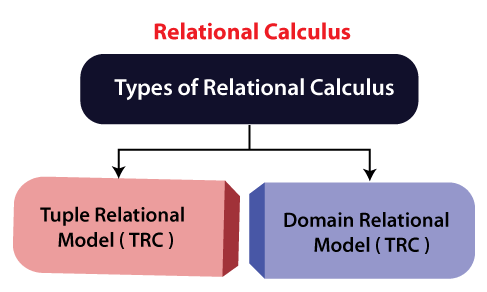
Relational Calculus: Tuple Relational Calculus, Domain Relational Calculus
Relational Calculus
- Relational calculus is a non-procedural query language. In the non-procedural query language, the user is concerned with the details of how to obtain the end results.
- The relational calculus tells what to do but never explains how to do.
Types of Relational calculus:

Relational algebra
Relational algebra is a procedural query language, which takes instances of relations as input and yields instances of relations as output. It uses operators to perform queries. An operator can be either unary or binary. They accept relations as their input and yield relations as their output.
Wednesday
Unit 2: Keys
Unit 2: Integrity Constraints
Integrity Constraints
- Integrity constraints are a set of rules. It is used to maintain the quality of information.
- Integrity constraints ensure that the data insertion, updating, and other processes have to be performed in such a way that data integrity is not affected.
- Thus, integrity constraint is used to guard against accidental damage to the database.
Unit 2: Relational Model (Introduction)
Relational Model was proposed by E.F. Codd to model data in the form of relations or tables. After designing the conceptual model of Database using ER diagram, we need to convert the conceptual model in the relational model which can be implemented using any RDMBS languages like Oracle SQL, MySQL etc. So we will see what Relational Model is.
Monday
DBMS
| Syllabus | |
| Text Book | Reference Book |
Introduction: [Basic concepts, Advantages of DBMS over file-processing systems, Data abstraction, Data models and data independence, Components of DBMS and overall structure of DBMS]
Data modeling, entities, attributes, relationships, constraints, Keys, E-R diagrams, and components of the E-R model
Entity-Relationship Model (study Material and PPT)
--------------------------------------------------------------------------------------------------------------
Relational Model: Basic concepts, Attributes and domains, Concept of integrity and referential constraints, Schema diagram, Relational query languages, Relational Algebra and Relational Calculus: Tuple relational and domain relational calculus
Unit 2: Relational Model Overview
Unit 2: Relational Calculus : Tuple Relational calculus, Domain relational calculus
----------------------------------------------------------------------------------------------------------
- Introduction to SQL, characteristics, advantages, data types, and literals
- DDL, creating, modifying, and deleting tables, Views: Creating, Dropping, Updation using views, DML, Operators, SQL DML queries, SELECT query and clauses. Structured Query Language- II: Set operations, Predicates and joins, Set membership, Tuple variables, Set comparison, Ordering of tuples, Aggregate functions, Nested queries, Database modification using SQL Insert, Update and Delete queries, Dynamic and SQL and concept of stored procedures, Queryby-example
| 1. Introduction to SQL | ||
| 2. Intermediate SQL | ||
| 3. Advanced SQL |
-------------------------------------------------------------------------------------------------------
UNIT IV: Relational Database Design and Storage Systems
- Notion of normalized relations
- Functional dependency, decomposition, and properties
- Questions [Explain trivial dependency? 2 marks
- What is meant by the closure of functional dependencies? Illustrate with anexample.
- What is Functional Dependency? Explain types and properties of FD’s.
- ]
- Normalization using functional dependency, multi-valued dependency, and join dependency
- Normalizations ( 1 nf,2nf,3nf,bcnf,4nf,5nf) and examples
- Questions:
- What is normalization? Explain its need.
- Explain insertion, deletion and modification anomalies with suitable examples.
- State BCNF. How does it differ from 3NF?
- State 1NF, 2NF & 3NF and explain with examples.
- Storage systems: secondary storage, RAID,
- 4. RAID
- file organization : Click here
- Indices, static and dynamic hashing
- click here
- Distinguish between: i) Primary and Secondary indexing. ii) Ordered indexing and hashing.
- B-Trees and B+ Trees
UNIT V: Query Processing and Transaction Management
- Measures of query cost
- Selection operation, sorting, and join operation
- Transaction concept, components of transaction management
- Concurrency and recovery system
- Concurrency control protocols (timestamps, locking), validation
- click here
- Multiple granularity, deadlock handling
- click here
- Crash recovery methods (log-based recovery, shadow-paging)
- Buffer management and
- remote backup system
- Click here
- [Question : Write in detail about Remote Backup systems?]
Syllabus: DBMS
Course Objectives:
- Understand database management systems architecture and functioning.
- Learn the relational model.
- Use structured query language (SQL) and its syntax, transactions, database recovery, and query optimization techniques.
- Acquaint with various normalization forms and query processing.
- Learn indexing methods.
Course Outcomes: After completing the course, students should be able to:
- Explain the need for database management.
- Design and implement a database schema for a given problem domain.
- Normalize a database.
- Create and query a database using SQL DML/DDL commands, stored procedures, and functions.
- Declare and enforce integrity constraints on a database.
- Demonstrate an understanding of indexing methods.
Course Contents: UNIT I: Introduction and Entity-Relationship Model
- Basic concepts, advantages of DBMS over file-processing systems
- Data abstraction, data models, and data independence
- Components and overall structure of DBMS
- Data modeling, entities, attributes, relationships, constraints
- Keys, E-R diagrams, and components of the E-R model
UNIT II: Relational Model and SQL-I
- Basic concepts of the relational model
- Attributes, domains, integrity and referential constraints
- Schema diagram, relational query languages
- Relational algebra and relational calculus
- Tuple and domain relational calculus
- Introduction to SQL, characteristics, advantages, data types, and literals
- DDL, creating, modifying, and deleting tables
UNIT III: Views and SQL-II
- Creating, dropping, and updating views
- DML operators, SQL DML queries, SELECT query and clauses
- Set operations, predicates, and joins
- Set membership, tuple variables, set comparison
- Ordering of tuples, aggregate functions
- Nested queries, database modification using SQL
- Insert, update, and delete queries
- Dynamic SQL and stored procedures
- Query-by-example
UNIT IV: Relational Database Design and Storage Systems
- Notion of normalized relations
- Functional dependency, decomposition, and properties
- Normalization using functional dependency, multi-valued dependency, and join dependency
- Storage systems: secondary storage, RAID, file organization
- Indices, static and dynamic hashing
- B-Trees and B+ Trees
UNIT V: Query Processing and Transaction Management
- Measures of query cost
- Selection operation, sorting, and join operation
- Transaction concept, components of transaction management
- Concurrency and recovery system
- Concurrency control protocols (timestamps, locking), validation
- Multiple granularity, deadlock handling
- Crash recovery methods (log-based recovery, shadow-paging)
- Buffer management and remote backup system
Text Books:
- Abraham Silberschatz, Henry F. Korth, and S. Sudarshan, "Database System Concepts," McGraw Hill Education, 6th Edition, 2011.
- Ramez Elmasri and Shamkant B. Navathe, "Fundamental Database Systems," Pearson Education, 7th Edition, 2015.
- Raghu Ramkrishnan, Johannes Gehrke, "Database Management Systems," McGraw Hill Education, 3rd Edition, 2007.
Reference Books:
- Carlos Coronel, Steven Morris, "Database Systems: Design Implementation and Management," Cengage Learning Press, 11th Edition, 2014.
- J. Murach, "Murach's MySQL," Shroff Publication, 2nd Edition, 2016.
- J. Murach, "Murach's Oracle SQL and PL/SQL: Works with All Versions Through 11g," Shroff Publication, 2008.
Recent
Weekly
-
Week 1: Indian Knowledge System – An Introduction Define Indian Knowledge System (IKS) and explain its significance. Why is it neces...
-
Components of Data Communication The following are the key components in a data communication system: Message Message is the informati...
-
Class-Responsibility-Collaborator (CRC) Modeling Class-responsibility-collaborator (CRC) modeling [Wir90] provides a simple means for ident...
-
Q. 1 What is meant by Data Communication and explain its characteristics? Q. 2 Define Data Communication. 1. Data communication is the proce...
-
🧠 1. Artificial Neuron Model (Base Formula) An artificial neuron computes a weighted sum of its inputs and then applies an activation fu...
-
Unit1: A) What is the Indian Knowledge System (IKS)? Explain its significance in today's world. B) Discuss the organization of t...
-
Syllabus Text Book Reference Book ---------------------------------------------------------------------------...
-
Two devices can communicate in simplex, half-duplex or full-duplex mode. Simplex: In simplex mode, the communication is unidirectional. Onl...
-
What is class based modeling Class-based modeling represents the objects that the system will manipulate, the operations (also called meth...
-
syllabus Question Bank DATA PRIVACY MTCSPE1001D UNIT I Questions Define data linking and profiling in the context of privacy. ...


