Extra video: IIT kharagpur
Showing posts with label Digital Image Processing. Show all posts
Showing posts with label Digital Image Processing. Show all posts
Monday
basic relationship between pixels
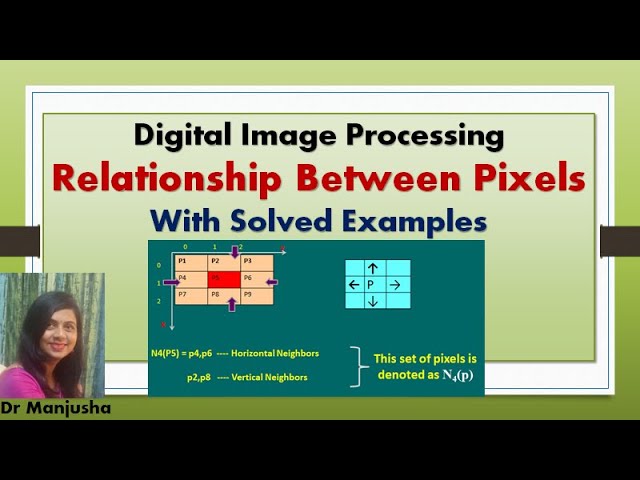

Unit 1 (part1)
Unit 1
Digital Image Processing – Introduction to Digital Image Processing
Subject – Image Processing and Machine VisionVideo Name – Digital Image ProcessingChapter – Introduction to Digital Image ProcessingFaculty – Prof. Vaibhav P…
Origins of Digital Image Processing – Introduction to Digital Image Processing
Subject – Image Processing and Machine VisionVideo Name – Origins of Digital Image ProcessingChapter – Introduction to Digital Image ProcessingFaculty – Prof…
Applications of Digital Image Processing – Introduction to Digital Image Processing
Subject – Image Processing and Machine VisionVideo Name – Applications of Digital Image ProcessingChapter – Introduction to Digital Image ProcessingFaculty -…
Fundamental Steps in Digital Image Processing – Introduction to Digital Image Processing
Subject – Image Processing and Machine VisionVideo Name – Fundamental Steps in Digital Image ProcessingChapter – Introduction to Digital Image ProcessingFacu…
Components of Image Processing System – Introduction to Digital Image Processing
Components of Image Processing System Video Lecture from Introduction to Digital Image Processing Chapter of Digital Image Processing Subject for all Enginee…

Structure of Human Eye – Digital Image Fundamentals – Image Processing and Machine Vision
Subject – Image Processing and Machine VisionVideo Name – Structure of Human EyeChapter – Digital Image FundamentalsFaculty – Prof. Vaibhav PanditWatch the v…
Image Formation in The Eye – Digital Image Fundamentals – Image Processing and Machine Vision
Subject – Image Processing and Machine VisionVideo Name – Image Formation in The EyeChapter – Digital Image FundamentalsFaculty – Prof. Vaibhav PanditWatch t…
Image Sensing and Image Acquisition – Digital Image Fundamentals – Image Processing & Machine Vision
Subject – Image Processing and Machine VisionVideo Name – Image Sensing and Image AcquisitionChapter – Digital Image FundamentalsFaculty – Prof. Vaibhav Pand…
Image Sampling and Quantization – Digital Image Fundamentals – Image Processing and Machine Vision
Subject – Image Processing and Machine VisionVideo Name – Image Sampling and QuantizationChapter – Digital Image FundamentalsFaculty – Prof. Vaibhav PanditWa…
Classification of Digital Images – Digital Image Fundamentals – Digital Image Processing
Classification of Digital Images Video Lecture from Digital Image Fundamentals Chapter of Digital Image Processing Subject for all Engineering Students.Acces…
Types of Images – Digital Image Fundamentals – Image Processing and Machine Vision
Subject – Image Processing and Machine VisionVideo Name – Types of ImagesChapter – Digital Image FundamentalsFaculty – Prof. Vaibhav PanditWatch the video le…

Sunday
Digital Image Processing Lab Syllabus
Course Title: Digital Image Processing Lab
Semester VI
Course Code BTITL608
Course Type Mandatory
Pre-requisite OOP with C++
L – T – P 0 – 0 – 2 Stream
Core Credits 1
Lab Experiments List: Study of “Matlab/Scilab or any other open source Image Processing Toolbox” and experiments as per the syllabus, to be decided by the concerned faculty.
Thursday
Digital Image Processing Syllabus
Course Title: Digital Image Processing
Semester VI
Course Code BTITC604
Course Type Elective
Pre-requisite
L – T – P - 3 – 0 – 0
Stream Core Credits 3
Course Objectives: 1. To cover the fundamentals and mathematical models in digital image and video processing. 2. To develop time and frequency domain techniques for image enhancement. 3. To expose the students to current technologies and issues in image and video processing. 4. To develop image and video processing applications in practice.
Course Outcomes: At the end of this course, students will be able to: 1. Understand theory and models in Image and Video Processing. 2. Interpret and analyze 2D signals in frequency domain through image transforms. 3. Apply quantitative models of image and video processing for various engineering applications. 4. Develop innovative design for practical applications in various fields.
Course Content:
UNIT I Image fundamentals: Image acquisition, sampling and quantization, image resolution, basic relationship between pixels, color images, RGB, HSI and other models.
UNIT II Two dimensional transforms: 2D-Discrete fourier transform, discrete cosine transform, Walsh Hadamard transform, Haar transform, KL transform, and discrete wavelet transform.
UNIT III Spatial domain Processing: Point processing such as digital negative, contrast stretching, thresholding, gray level slicing, bit plane slicing, log transform and power law transform, neighbourhood processing such as averaging filters, order statistics filters, high pass filters and high boost filters, histogram equalization and histogram specification, frequency domain such as DFT for filtering, ideal, Gaussian and butterwort filters for smoothening and sharpening, and homomorphic filters.
UNIT IV Image segmentation and morphology: Point, line and edge detection, edge linking using Hough transform and graph theoretic approach, thresholding, and region based segmentation, dilation, erosion, opening, closing, hit or miss transform, thinning and thickening, and boundary extraction on binary images.
UNIT V Degradation model, noise models, estimation of degradation function by modelling, restoration using Weiner filters and inverse filters.
UNIT VI Video formation, perception and representation: Digital video sampling, video frame classifications, I, P and B frames, notation, ITU-RBT 601 digital video formats, digital video quality measure, video capture and display: principle of colour video camera, video camera, digital video, sampling of video signals: required sampling rates, sampling in two dimensions and three dimensions, progressive virus interlaced scans, two dimensional motion estimation, block matching algorithms.
Text Books: 1. Gonzales and Woods, "Digital Image Processing", Pearson Education, India, Third Edition. 2. Anil K.Jain, "Fundamentals of Image Processing", Prentice Hall of India, First Edition, 1989.
Reference Books: 1. Ze-Nian Li and Mark S. Drew, "Fundamentals of Multimedia", PHI 2011. 2. Murat Tekalp, "Digital Video Processing", Pearson, 2010. 3. John W. Woods, "Multidimensional Signal, Image and Video Processing", Academic Press 2012. 6. A.I.Bovik, "Handbook on Image and Video Processing", Academic Press.
Subscribe to:
Posts (Atom)
Weekly
-
 Class-Responsibility-Collaborator (CRC) Modeling Class-responsibility-collaborator (CRC) modeling [Wir90] provides a simple means for ident...
 -
Week 1: Indian Knowledge System – An Introduction Define Indian Knowledge System (IKS) and explain its significance. Why is it neces...
-
 Components of Data Communication The following are the key components in a data communication system: Message Message is the informati...
 -
Syllabus Text Book Reference Book ---------------------------------------------------------------------------...
-
What is class based modeling Class-based modeling represents the objects that the system will manipulate, the operations (also called meth...
-
🧠 1. Artificial Neuron Model (Base Formula) An artificial neuron computes a weighted sum of its inputs and then applies an activation fu...
-
Unit1: A) What is the Indian Knowledge System (IKS)? Explain its significance in today's world. B) Discuss the organization of t...
-
 Two devices can communicate in simplex, half-duplex or full-duplex mode. Simplex: In simplex mode, the communication is unidirectional. Onl...
 -
Text books Course objectives and Course Outcomes UNIT I: Fundamentals of Data Communication and Computer Network [08 Hours] Data and Informa...
-
syllabus Question Bank DATA PRIVACY MTCSPE1001D UNIT I Questions Define data linking and profiling in the context of privacy. ...